GNLP 2045 Regulation 20 Scoping Consultation
Other elements in this consultation
7. Housing
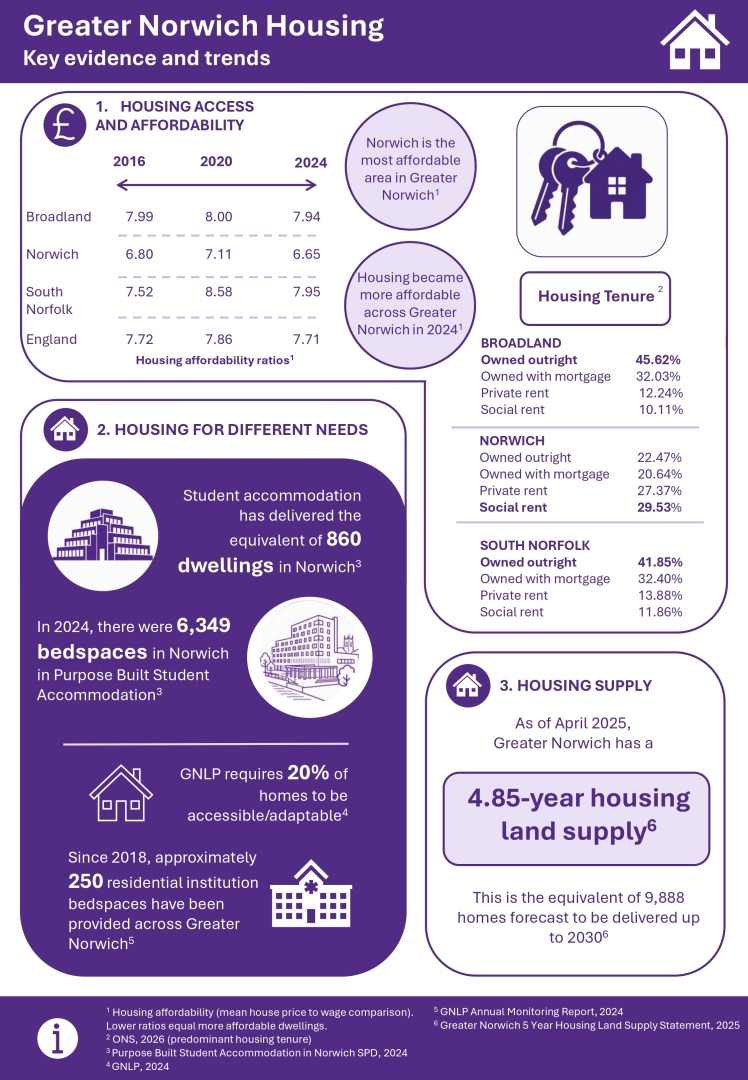
Greater Norwich Housing: key evidence and trends (full text)
1. HOUSING ACCESS AND AFFORDABILITY
Table 1: Housing affordability ratios[1]
|
Area |
2016 |
2020 |
2024 |
|
Broadland |
7.99 |
8.00 |
7.94 |
|
Norwich |
6.80 |
7.11 |
6.65 |
|
South Norfolk |
7.52 |
8.58 |
7.95 |
|
England |
7.72 |
7.86 |
7.71 |
Norwich is the most affordable area in Greater Norwich[1].
Housing became more affordable across Greater Norwich in 2024[1].
Housing tenure:
Table 2: Housing tenure[2]
|
Tenure |
Broadland |
Norwich |
South Norfolk |
|
Owned outright |
45.62% |
22.47% |
41.85% |
|
Owned with mortgage |
32.03% |
20.64% |
32.40% |
|
Private rent |
12.24% |
27.37% |
13.88% |
|
Social rent |
10.11% |
29.53% |
11.86% |
2. HOUSING FOR DIFFERENT NEEDS
Student accommodation ahs delivered the equivalent of 860 dwellings in Norwich[3].
In 2024, there were 6,349 bedspaces in Norwich in Purpose Built Student Accommodation[3].
GNLP requires 20% of homes to be accessible/adaptable[4].
Since 2018, approximately 250 residential institution bedspaces have been provided across Greater Norwich[5].
3. HOUSING SUPPLY
As of April 2025, Greater Norwich has a 4.85-year housing land supply[6].
This is the equivalent of 9,888 homes forecast to be delivered up to 2030[6].
References
[1] Housing affordability (mean house price to wage comparison). Lower ratios equal more affordable dwellings.
[2] ONS, 2026 (predominant housing tenure).
[3] Purpose Built Student Accommodation in Norwich SPD, 2024.
[4] GNLP, 2024.
[5] GNLP Annual Monitoring Report, 2024.
[6] Greater Norwich 5 Year Housing Land Supply Statement, 2025.
Deliverability and Housing Supply
1Maintaining a five-year housing land supply and ensuring its delivery is challenging and largely market-led. As of April 2025, Greater Norwich has a 4.85-year housing land supply. Whilst this is the equivalent of nearly 10,000 homes forecast to be delivered up to 2030, this is below the required 5-year supply. This means that the presumption in favour of sustainable development (also known as the “tilted balance”) is currently applied to planning applications for housing. This shifts the decision-making balance in favour of approval. Instead of an applicant having to prove that a proposal fully complies with policy, the LPA must show that the harms are sufficiently serious to outweigh the benefits.
2Consequently, we are keen to explore how delivery rates can be raised to help to deliver enough homes to meet the current and future needs of our area.
3It is important to recognise that, despite there being clear demand for new homes, there are delivery challenges affecting housebuilding both nationally and locally. This is largely due to a combination of factors:
- major increases in construction and labour costs in recent years, caused by, in particular, Covid and the Ukraine war
- increased regulatory requirements and costs for compliance (such as Biodiversity Net Gain, the Building Safety Levy and the Future Homes Standard)
- increased borrowing costs of capital for developers and
- challenges on the demand-side due to the withdrawal of Help to Buy, the cost-of-living crisis and general affordability challenges.
4These factors lead to significant viability pressures and challenges to delivery in our area and not just for brownfield sites.
5Ongoing major projects at Anglia Square and East Norwich have required public investment to unlock these strategic brownfield sites due to high infrastructure needs, abnormal costs, and other viability challenges, including providing affordable housing.
6As a result of the above, there have been re-negotiations following permissions being granted on sites of all scales and types across Greater Norwich.
7The draft NPPF requires a greater mix of site sizes, including at least 10% of housing to meet the total housing requirement to be allocated on small sites (of no larger than 1 hectare) and 10% on medium scale sites. Medium scale development for housing is defined in the NPPF as where 10-49 homes (inclusive) will be provided, and the site has an area of up to 2.5 hectares.
Question 8 - What measures could the councils take to improve housing delivery rates through the local plan?
Question 9 - The plan must include 10% of homes on both small and medium-sized sites. Should the plan aim to allocate a higher proportion than this and, if so, why?
Affordable Housing
8Affordable housing delivery has varied across the area and is influenced by viability, site delivery approaches, and local authority investment.
Table 1: Units of Affordable Housing delivered during the GNLP plan period, as a proportion of total unit completions.
|
Local authority |
2018/19 |
2019/20 |
2020/21 |
2021/22 |
2022/23 |
2023/24 |
2024/25 |
|---|---|---|---|---|---|---|---|
|
Broadland |
195 (30%) |
211 (32%) |
165 (33%) |
177 (27%) |
387 (42%) |
314 (35%) |
289 (36%) |
|
Norwich |
137 (13%) |
184 (23%) |
20 |
64 (20%) |
72 (32%) |
83 (15%) |
72 (40%) |
|
South Norfolk |
392 (32%) |
263 (29%) |
129 (16%) |
147 (16%) |
263 (22%) |
403 (46%) |
333 (37%) |
|
Greater Norwich |
721 (25%) |
658 (28%) |
314 (20%) |
388 (21%) |
722 (31%) |
800 (34%) |
694 (37%) |
9Largely reflecting differing development costs, policy 5 of the adopted GNLP requires a minimum of 28% affordable housing in Norwich City Centre and 33% elsewhere. Overall, as illustrated in table 1 above, affordable housing delivery has been fairly strong, especially in recent years. This is reflected in recent national data which shows that Greater Norwich delivered 13.3 affordable homes per thousand people in the ten years to 2024/25, compared to an English national average of 9.4. However, some sites have not been able to meet the above targets due to increases in development costs.
10Based on updated evidence to be commissioned through a Housing Needs Assessment and the Whole Plan Viability Report, the GNLP 2045 will set affordable housing requirements, as required by the draft NPPF, and consider mechanisms such as on-site provision, commuted sums, clawback and tenure flexibility (see the glossary for definitions).
Housing Mix and Specialist Needs
11The GNLP 2045 must respond to a range of housing needs, including for older people, disabled people, students, and those needing supported housing. Based on updated evidence commissioned through a Housing Needs Assessment, the GNLP 2045 will need to include policies and allocations to address this range of needs.
12The adopted GNLP requires 20% accessible and adaptable homes (M4(2)) and encourages, rather than obliges, M4(3) wheelchair-user dwellings to be provided. The more recent draft NPPF (2025) suggests that at least 40% of new housing delivered over the course of a local plan period should be adaptable, accessible or for wheelchair users.
Gypsy and Traveller and Travelling Showpeople Accommodation
13The draft NPPF includes a criteria-based policy for assessing windfall Gypsy and Traveller sites so such a policy will not be required in the GNLP 2045. However, the draft NPPF requires local plans to allocate sufficient sites to meet needs for Gypsy and Traveller and Travelling Showpeople accommodation.
14Existing evidence will be updated through the Housing Needs Assessment to determine whether additional allocations will be required, and if so, how many pitches and plots will be needed. The adopted GNLP has allocated sites and has windfall policies which aim to provide 52 pitches, including a criteria-based policy for assessing applications, from 2022 to 2038. To date, no pitches have been delivered since 2022. Current forecasts indicate that 15 pitches are expected to be delivered by 2032.
15Depending on evidence of need, local plans usually:
- allocate specific sites for Gypsy and Traveller accommodation;
- include plot requirements as part of large housing allocations
- or take a blended approach of the two above.
16The draft NPPF stipulates that local plans must provide for self/custom build housing demand, informed by registers and needs assessments.
Self-Build and Custom-Build Housing
Question 10 - What should the GNLP 2045 do to assist the delivery of:
- affordable housing
- accessible and adaptable homes
- specialist housing
- gypsy and traveller and travelling showpeople sites
- self- and custom-build housing
Rural Housing, Homes Outside Settlements and Conversions
17As draft NPPF policies HO10 and HO11 cover rural exception sites and isolated homes in the countryside, it is not currently our intention to add to these policies. HO10 provides a route for affordable and community-led housing on exception sites outside settlements, while HO11 limits new isolated countryside homes to a small number of justified circumstances. However, we would be interested to hear your views on whether additional local policy on these issues may be necessary.
18Section S5 of the draft NPPF, lists the certain forms of development that should be approved outside settlements. These categories are redevelopment of previously developed land, limited infilling of houses, rural exceptions sites housing, housing near well-connected railway stations, and the limited circumstances for allowing isolated homes in the countryside (under policy HO11).
19Whilst not addressed in the same level of detail within the draft NPPF, existing policies in the GNLP and the adopted Broadland and South Norfolk Development Management Policies already set out a range of circumstances in which residential development may be acceptable in the countryside. These include provisions relating to self-build and custom-build housing, the conversion of existing rural buildings, replacement dwellings, the subdivision of existing dwellings, and dwellings connected to rural enterprises.
Question 11 - Should the GNLP 2045:
- Provide additional coverage of rural housing and development outside settlement limits beyond that contained in the draft NPPF?
- Retain aspects of existing local policy concerning housing outside settlement limits, such as self-build and custom-build housing, barn and other rural building conversions, replacement dwellings, the subdivision of existing dwellings, and dwellings connected to rural enterprises?
