GNLP 2045 Regulation 20 Scoping Consultation
Other elements in this consultation
9. Infrastructure
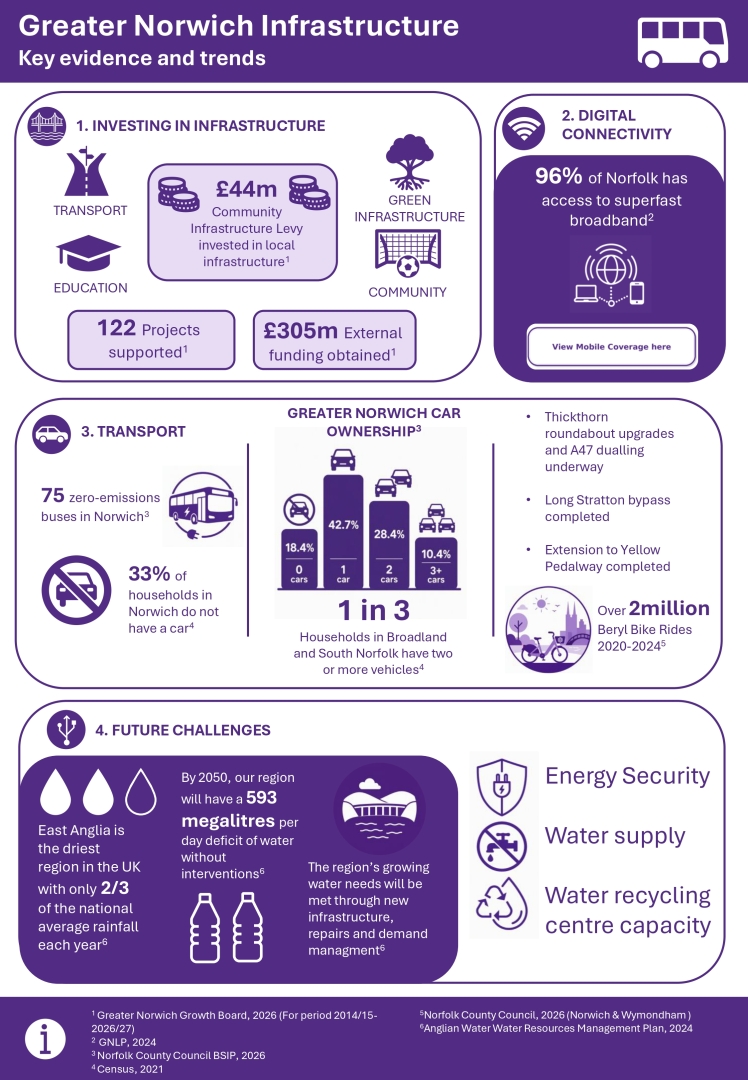
Greater Norwich Infrastructure: key evidence and trends (full text)
1. INVESTING IN INFRASTRUCTURE
£44m of Community Infrastructure Levy invested in local infrastructure[1].
Infrastructure investment categories:
- Transport
- Education
- Green Infrastructure
- Community
122 Projects supported[1]
£305m External funding obtained[1]
2. DIGITAL CONNECTIVITY
96% of Norfolk has access to superfast broadband[2].
The factsheet also includes a button labelled:
"View Mobile Coverage here".
This links to the following webpage: Map Your Mobile
3. TRANSPORT
75 zero-emissions buses in Norwich[3].
33% of households in Norwich do not have a car[4].
Greater Norwich Car Ownership[3]
Car ownership distribution:
- 18.4% of households have 0 cars
- 42.7% of households have 1 car
- 28.4% of households have 2 cars
- 10.4% of households have 3 or more cars
1 in 3 Households in Broadland and South Norfolk have two or more vehicles[4] .
Transport schemes and improvements:
- Thickthorn roundabout upgrades and A47 dualling underway
- Long Stratton bypass completed
- Extension to Yellow Pedalway completed
Over 2 million Beryl Bike Rides 2020-2024[5] .
4. FUTURE CHALLENGES
Water Resources
East Anglia is the driest region in the UK with only 2/3 of the national average rainfall each year[6] .
By 2050, our region will have a 593 megalitres per day deficit of water without interventions[6] .
The region's growing water needs will be met through new infrastructure, repairs and demand management[6] .
Key Infrastructure Challenges
- Energy Security
- Water supply
- Water recycling centre capacity
References
[1] Greater Norwich Growth Board, 2026 (For period 2014/15-2026/27).
[2] GNLP, 2024.
[3] Norfolk County Council BSIP, 2026.
[4] Census, 2021.
[5] Norfolk County Council, 2026 (Norwich & Wymondham).
[6] Anglian Water: Water Resources Management Plan, 2024.
Overall approach
1Infrastructure provision will be central to delivering sustainable growth across Greater Norwich, including transport, utilities, digital networks, education, healthcare and community services. Pressures are increasing from growth, climate change and changing service delivery models, requiring a coordinated and forward-looking approach to benefit both new and existing communities.
2In the current local plan, GNLP Policy 4 stresses that coordinated, flexible, and timely infrastructure delivery, at both strategic and local levels, is critical to achieving sustainable growth in Greater Norwich. This is informed by evidence from the Greater Norwich Infrastructure Plan (GNIP) to identify what infrastructure is needed to support planned growth. This evidence will be updated for the GNLP 2045. Further to this, Appendix 1 of the GNLP lists infrastructure requirements at plan adoption in 2024. These requirements are being updated regularly to reflect changes over time and technological advances. Revised requirements will need to be established through the GNLP 2045.
Infrastructure funding and delivery
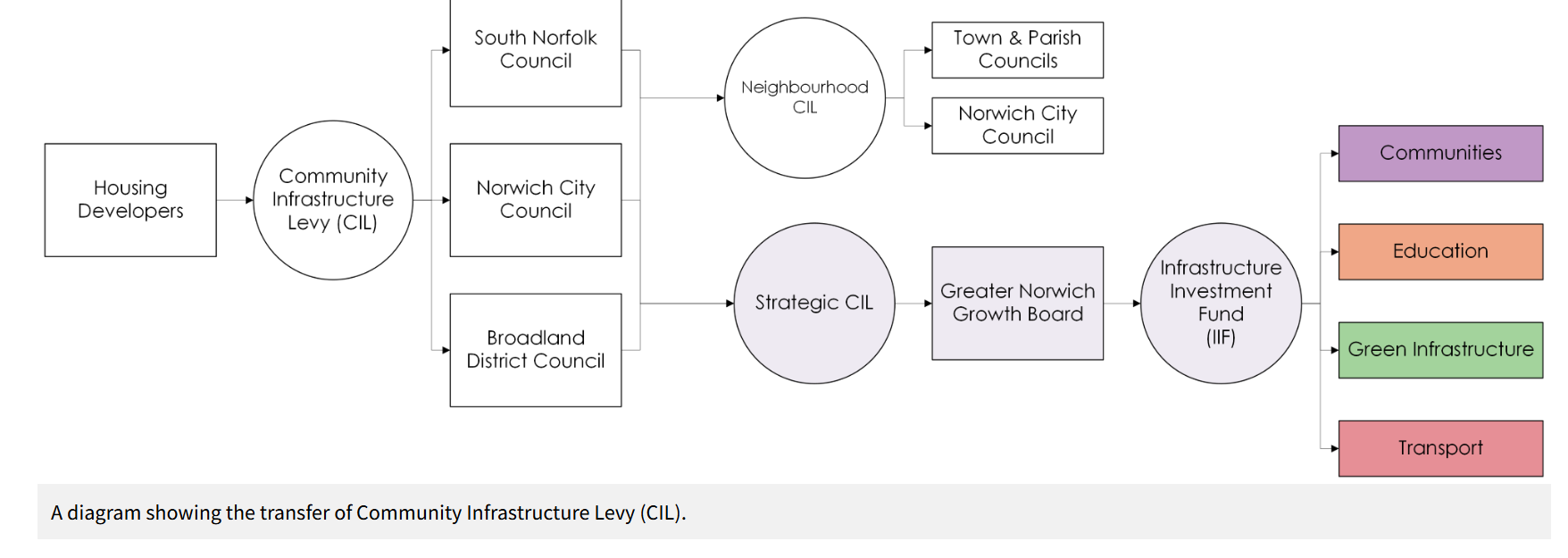
3Infrastructure is funded through a mix of developer contributions (including Community Infrastructure Ley (CIL)), public funding, private sector delivery and partnerships. Securing timely delivery alongside development remains a key challenge, with the viability of infrastructure delivery sometimes a difficulty.
4Some infrastructure planning and spending is undertaken through the Greater Norwich Growth Board, using the GNIP to identify and deliver projects in a timely way.
Transport and accessibility
Roads
5Three major trunk road improvements are being completed on the A47, the Blofield-Burlingham dualling (largely completed by summer 2026), the Easton-Tuddenham dualling (due to complete in spring 2027) and the Thickthorn A47/A11 roundabout improvements (due to complete in spring 2028). These will improve journey times and reliability for road users.
6On the non-trunk road network, one of the most significant recent improvements was the completion of the Long Stratton A140 bypass, which opened in summer 2025.
Cycling and walking
7The Norfolk and Greater Norwich Local Cycling and Walking Improvement Plans (LCWIPs) have a prioritised programme of improvements across the area and county. Various improvements have been made in recent years, including an extension to the Yellow Pedalway close to the airport in 2025 and 2026. Other improvements have been made to the Marriott’s Way cycling and walking path, together with various other local schemes.
Public transport
8Railway services from Norwich run to Sheringham, Great Yarmouth, Lowestoft, Cambridge, Stansted Airport, Liverpool and London, with stations at Brundall, Brundall Gardens, Cantley, Reedham, Acle, Lingwood, Salhouse, Wroxham/Hoveton, Wymondham and Diss.
9Opportunities to improve train frequencies and speeds are limited on most lines due to lack of capacity and “track path” constraints (such as limited passing places on stretches of single track). Trowse swing bridge is a particular constraint in Norwich, with major capacity constraints at Ely (in Cambridgeshire) also limiting increased passenger and freight services to Cambridge, the Midlands and the North. The Norfolk Rail Prospectus (updated in 2024) sets out the County Council’s key short medium and long-term priorities for improved rail connectivity.
10There are 75 zero-emission buses in Norwich, helping to improve air quality in central Norwich in particular. Some bus operators serving Greater Norwich are still currently reliant on diesel fleets, however.
11Bus frequencies, especially in some rural areas and in evenings, can be very limited where services are not generally commercially viable. “Dial-a-ride”, “community taxis” and similar services can sometimes fill some of the gaps, but their availability is fragmented. But the main towns, such as Aylsham, Wymondham, Acle and Long Stratton, generally have a good bus service to Norwich. There have been recent improvements to some services through the Bus Service Improvement Plan and the national fare cap (currently £3 per journey, but dropping to £2 in January 2027) has also helped increase bus patronage.
Key issues
12There remain various congestion, carbon emissions and air quality problems in Greater Norwich. Accessibility to employment, services and leisure facilities, particularly in rural areas and deprived communities, is also a concern. Table 1 below shows the more limited vehicle ownership in Norwich and the more limited access to rail in Broadland and South Norfolk.
13There is a need to balance strategic road investment with a strong focus on public transport and active travel.
Table 1: Inequalities in private vehicle ownership and access to railway stations by district.
|
Local Authority District |
Households with no car or van ownership (%) |
Less than 15 minute walk to railway station (%) |
Less than 30 minute walk to railway station (%) |
Less than 60 minute walk to railway station (%) |
|---|---|---|---|---|
|
Broadland |
11.0 |
7 |
15 |
43 |
|
Norwich |
32.7 |
8 |
34 |
83 |
|
S. Norfolk |
10.5 |
6 |
17 |
30 |
Wastewater
14There are wastewater constraints in Greater Norwich, with various water recycling centres (sewerage treatment plants) at, or close to, capacity. The largest plant in Greater Norwich, Whitlingham, has a programme of qualitative and quantitative improvements proposed to try to ensure that it can meet the growing demand and some smaller plants have improvement plans in place, too.
15Nutrient neutrality is another significant constraint in Greater Norwich, with impacts on the River Wensum Special Area of Conservation (SAC) and Broads SAC currently requiring mitigation measures to be secured to allow development in most of Greater Norwich to progress (southern parts of South Norfolk are outside this zone).
16A Water Cycle Study will be commissioned to provide evidence of which improvements to water recycling plants will likely be necessary.
Energy
17The UK has a legal requirement to reach net zero by 2050 and the draft revised NPPF (Chapter 10) states how important it is to support the development and operation of energy infrastructure which aligns with clean power and net zero objectives. Consequently, the GNLP 2045 will need to support the transition to a low-carbon future in the context of increased demand for energy from data centres, electric cars, air source heat pumps, air conditioning and other energy uses.
18There have been an increasing number of solar farms constructed and proposed in recent years, as well as the Norwich to Tilbury high voltage network. Many of these projects are classed as Nationally Significant Infrastructure Projects (NSIPs), so fall outside the direct control of the local planning system.
19Various other grid improvements are identified in the current GNLP and more are likely to be necessary to support additional growth. Other potential means of supporting net zero objectives include the promotion of energy efficiency, smaller scale renewables and heat networks.
20Building Regulations requirements mean that new dwellings starting after 23rd March 2027 must be constructed to the Future Homes Standard (FHS), which includes greater energy efficiency measures so that no new gas boilers will be permitted. The FHS effectively requires low-carbon heating, high building fabric efficiency and the use of on-site renewables. The default position to achieve the 75-80% reduction in CO2 emissions required (compared to the 2013 Building Regulations) will be that new housing has heat pumps, with solar panels. The only viable alternative to heat pumps would be linking to a low-carbon heat network, which may be a future possibility in densely developed parts of Norwich if such a network is delivered.
21The draft NPPF is clear that local plans should not set local energy efficiency standards.
Digital connectivity
22Digital connectivity is essential in modern society, but some gaps remain in broadband and mobile coverage in the Greater Norwich area. National policy supports the rollout of gigabit broadband and 5G, and new development is required to provide high-quality digital infrastructure through the Building Regulations requirements.
23Some new developments, especially any urban extensions or new settlements, may require new/additional mobile phone towers to ensure adequate coverage.
Schools, healthcare and community facilities
24Depending on the scale and location, growth will, in some cases, require new/expanded schools, healthcare facilities (including dental surgeries), police and/or fire infrastructure and community infrastructure (such as community centres and libraries). This will need to be planned carefully with infrastructure providers to ensure that best use is made of existing capacity and that the new/improved infrastructure can be provided in a timely way.
25Healthcare delivery is increasingly shifting away from primary (GP) and acute (hospital) care towards local, community-based provision, increasing the need for some new, locally-accessible facilities. There may also be a need for new/relocated ambulance stations and new/expanded policing and fire infrastructure to serve new developments.
26It is worth noting that although the GNLP 2045 could potentially require and plan for new/improved healthcare (including dental), fire and police infrastructure, it cannot play a direct role in the staffing of them – this is for the NHS and the fire and police authorities to manage.
Table 2: Selected health facilities per 100,000 people per district.
|
Local Authority District |
GP surgeries |
Prescribing dispensaries |
Dental practices |
|---|---|---|---|
|
Broadland |
13.28 |
12.54 |
11.80 |
|
Norwich |
15.11 |
18.55 |
21.29 |
|
South Norfolk |
10.91 |
12.96 |
10.23 |
27Additional growth will place pressure on sports and leisure provision and other community infrastructure, requiring upgrades or new facilities in some areas. This could include (for example) football pitches, cricket fields, sports halls, village halls, playgrounds and libraries.
28Studies will be commissioned to best understand how much additional provision is required, and where it is best needed, such as a Playing Pitch and Built Facilities Study.
Table 3: Access to libraries by district.
|
Local Authority District |
Residents age 65 and over (%) |
Less than 15 minute walk to library (%) |
Less than 30 minute walk to library (%) |
Less than 60 minute walk to library (%) |
|---|---|---|---|---|
|
Broadland |
25.9 |
33 |
58 |
79 |
|
Norwich |
15.0 |
46 |
97 |
100 |
|
S. Norfolk |
24.6 |
28 |
48 |
76 |
Question 16 - How should the GNLP 2045 support
- Improved accessibility to housing, employment, services, sports and other community facilities?
- Delivery of wastewater treatment capacity and address nutrient neutrality?
- Clean power and net zero objectives?
