GNLP 2045 Regulation 20 Scoping Consultation
Other elements in this consultation
8. The Economy
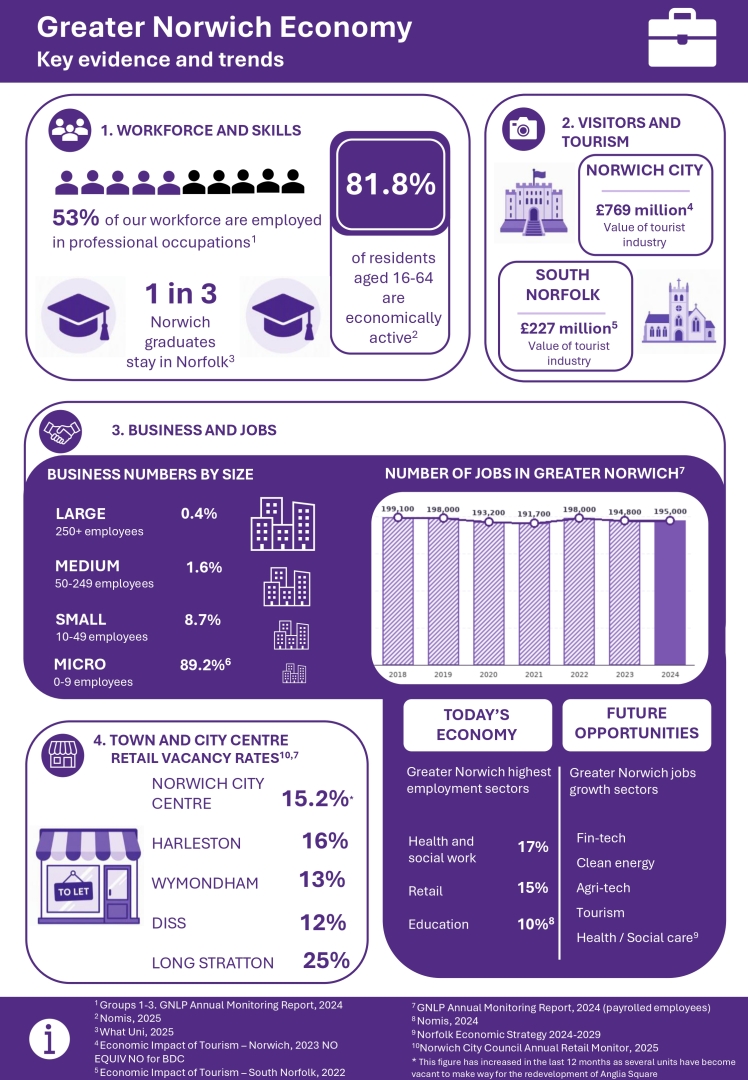
Greater Norwich Economy: key evidence and trends (full text)
1. WORKFORCE AND SKILLS
53% of our workforce are employed in professional occupations[1].
81.8% of residents aged 16-64 are economically active[2].
1 in 3 Norwich graduates stay in Norfolk[3].
2. VISITORS AND TOURISM
Annual value of tourist industry:
- Norwich City: £769 million[4]
- South Norfolk: £227 million[5]
3. BUSINESS AND JOBS
Business numbers by size[6]:
- Large (250+ employees): 0.4% of all businesses
- Medium (50-249 employees): 1.6% of all businesses
- Small (10-49 employees): 8.7% of all businesses
- Micro (0-9 employees): 89.2% of all businesses
A graph showing the number of jobs in Greater Norwich[7] from 2018 to 2024. The number has stayed steady at just under 200,000 during that time.
Today’s economy
Greater Norwich highest employment sectors[8]:
- Health and social work: 17%
- Retail: 15%
- Education: 10%
Future opportunities
Greater Norwich jobs growth sectors[9]:
- Fin-tech
- Clean energy
- Agri-tech
- Tourism
- Health / Social care
4. TOWN AND CITY CENTRE RETAIL VACANCY RATES[10,7]
Norwich City Centre: 15.2%*
Harleston: 16%
Wymondham: 13%
Diss: 12%
Long Stratton: 25%
References
[1] Groups 1-3. GNLP Annual Monitoring Report, 2024.
[2] Nomis, 2025.
[3] What Uni, 2025.
[4] Economic Impact of Tourism – Norwich, 2023. NO EQUIV NO for BDC.
[5] Economic Impact of Tourism – South Norfolk, 2022.
[6] Nomis, 2025.
[7] GNLP Annual Monitoring Report, 2024 (payrolled employees).
[8] Nomis, 2024.
[9] Norfolk Economic Strategy 2024-2029.
[10] Norwich City Council Annual Retail Monitor, 2025.
*This figure has increased in the last 12 months as several units have become vacant to make way for the redevelopment of Anglia Square.
1The GNLP 2045 will set out a long-term strategy to support a strong, flexible and sustainable economy. The following text and questions cover key drivers for the economy in Greater Norwich.
Flexibility and long-term growth
2The NPPF sets out that development plans must:
- have a clear economic vision which takes a positive, proactive and realistic approach to encouraging sustainable economic growth;
- allocation sites to implement the vision and to meet existing and anticipated economic need over the plan period; and
- respond to a modernising economy by having flexible and adaptable sites and premises.
3Our foundational economy, which provides a high number of jobs, contributes to Gross Value Added (GVA) and supports Greater Norwich’s residents includes:
- Culture, heritage and visitor economy
- Construction
- Health and Social Care
- Retailing.
4The Norfolk Local Growth Plan identifies the following as key economic growth sectors for Greater Norwich:
- Life sciences
- Clean energy
- Agri-tech and agri-food
- Financial services and insurance
- Digital Tech
- Advanced manufacturing and engineering.
5Evidence will be collected on the need for existing and additional employment allocations and on whether some employment areas require ongoing/new protection for specific end users/industries (e.g. Norwich airport, Norwich Research Park, Hethel Engineering Centre and the Food Enterprise Park (FEP)).
Workforce and education
6A large share of Norwich’s population (63%) is of working age providing a strong base to fuel future growth (Public First, 2026). Greater Norwich benefits from a high proportion of young working age adults aged 18-25, largely due to the concentration of higher education providers and a high graduate retention rate.
7The NPPF does not set out how local plan-making and decision-taking should consider workforce skills and education in shaping local areas. Greater Norwich can leverage the young population and strong graduate retention to drive business and employment growth.
The rural economy
8The NPPF takes a more permissive approach to the development of the rural economy than previously, particularly in relation to new and/or expanded development outside defined development boundaries and accommodation for rural workers. Particular focus is placed on supporting modernisation, as well as diversification opportunities for farms and agricultural enterprises. The NPPF recognises that such development may need to occur in less sustainable areas that are not well served by public transport.
9The diversification of existing agriculture and encouraging land-based enterprises can help support innovation and the modernisation of Greater Norwich’s rural economy.
Logistics and freight
10The NPPF supports the effective and efficient movement of goods.
11Whilst the ongoing A11 and A47 trunk road enhancements and the remainder of the road and rail network provide some opportunities for logistics and freight growth, Greater Norwich is not located at the heart of the national transport network and it currently seems unlikely that freight and logistics will form a key component of our local economy. Notwithstanding this, there may be a need for further secure parking (especially for the overnight period) for lorries and coaches. The Norfolk State of Freight study will help inform a future Freight Strategy.
SMEs and business start ups
12It is important to encourage an enterprising culture in Greater Norwich and to support residents to start up their own business, as well as for new start-ups to survive and thrive. Recent successful examples include the box park at St. Saviour’s Yard and the digital hub at Townsend House in Norwich, Hethel Engineering Centre, Diss Business Hub and Broadland Food Innovation Centre at Honingham Thorpe.
13As the NPPF has limited coverage on policy support for Small and Medium Enterprises (SMEs) and business start-ups, there may be the potential for a local policy on this.
Question 12 - How should the GNLP 2045:
- deliver the right types and mixes of flexible and adaptable commercial spaces in the right places?
- help our growth sectors to thrive, possibly including protection of site-specific industries?
- support other opportunities for economic growth, including the rural economy?
- strengthen skills and workforce development?
- plan for freight and logistics?
- support small businesses and start-ups?
City and Town Centres
14The NPPF requires identification of a hierarchy of retail centres, and a sequential test and impact assessment is necessary for proposals outside of these to help the protection and enhancement of the most accessible centres.
15Reflecting national economic trends, over the past decade Norwich city centre has experienced significant challenges, including stalled redevelopment projects, underused sites, and declining employment density. However, it remains the key retail hub for Norfolk and north Suffolk with a large catchment, high footfall and lower than national average vacancy rates.
16Town centres play a vital role in the rural economy. It is important that they remain attractive and vibrant, have a good range of shops and services and are accessible to residents and other visitors.
17An existing retail hierarchy is defined in the current GNLP (see policy 6) and is still considered to be broadly fit for purpose. However, some amendments may be needed to capture changes to these centres where they have experienced growth or decline over time, or may do so in the future. Consideration should also be given to how best to support and enhance our local and district centres.
18Evidence will be collected on the need for any additional retail or other town centre uses and on whether certain retail areas should continue to have their uses restricted (e.g. Sweetbriar Retail Park and Sprowston Retail Park).
19Both the Norwich DM policies Plan and the existing GNLP include a policy on the Late-Night Activity Zone (LNAZ) which only allows late night entertainment uses in the defined zones focused around Riverside and Prince Of Wales Road, and generally does not permit noise sensitive uses such as housing in or adjacent to the LNAZ. Leisure uses, including uses supporting the early evening economy, are however generally accepted within the defined city centre. The late-night entertainment market has declined locally and nationally, calling into question whether this policy approach which concentrates late night entertainment in certain areas remains appropriate.
Question 13 - How should the GNLP 2045:
- help strengthen the city, town, district and local centres?
- deal with thresholds for retail impact assessments?
- address the evening and the late-night economy in the city centre?
Tourism
20The NPPF does not set out how tourism can support a thriving local economy.
21Tourism plays a key role in supporting the economy of the region, both in Norwich and in rural areas, and it is important that both existing leisure and tourism attractions and new enterprises are supported in their ambitions for growth and development. This includes good quality tourist accommodation to encourage new and returning visitors to the area.
